Native American Proverb

Conserving ecosystems, protecting species, and promoting sustainability through science-driven action and partnership to ensure a resilient planet for future generations, while also supporting companies and initiatives that advance human health and wellness in alignment with ecological sustainability. Objectives include preventing habitat
Conserving ecosystems, protecting species, and promoting sustainability through science-driven action and partnership to ensure a resilient planet for future generations, while also supporting companies and initiatives that advance human health and wellness in alignment with ecological sustainability. Objectives include preventing habitat destruction, fostering ecological stewardship, and connecting human prosperity to the health of the natural world.

Our team is made up of passionate professionals, Scientists, and Entomologists who are committed to environmental protection. We have experts in sustainable agriculture, renewable energy, green chemistry and environmental policy who work together to achieve our mission.
Biodiversity is the variety of life on Earth. It underpins healthy resilient ecosystems that provide life’s essentials including: clean air, water, food medicines, climate and economic stability.
In essence, Biodiversity is Earth's life-support system, providing the foundational elements for all life, including our own.
This occurs when a particular area is converted from usable to unusable habitat. Industrial activities, agriculture, mining, deforestation and water extraction are all central causes of habitat loss. This includes deforestation for wood for cooking food.
Over harvesting and industrialized farming with widespread pesticides and herbicides contribute to the killing off of numerous species over the past several hundred years. The extinction of numerous insect species and the collapse of biomass is even threatening predators at the top of the food chain.
Climate is a major factor in the distribution of species across the globe; climate change forces them to adjust. But many are not able to cope with the unprecedented speed of the change.
Pollution drives biodiversity loss by poisoning organisms, destroying and degrading habitats (like through acid rain or plastic waste, disrupting food webs and species interactions like pollination. The discharge of toxic synthetic chemicals and heavy metals into the environment has a huge impact on species abundance and can lead to extinctions. It’s important to remember that substances that are “natural” can become pollution when they are too abundant in a certain area. For example, nitrogen and phosphorous are important nutrients for plant growth, but when they concentrate in water systems after being applied as agricultural fertilizers, they can cause “dead zones” that are uninhabitable for fish and other wildlife.
Invasive species cause biodiversity loss by outcompeting, preying on, or spreading diseases to native species, altering habitats and disrupting food webs, leading to declines and extinctions, especially in isolated environments like islands. They act as major drivers of extinction - creating monocultures and simplifying ecosystems, thereby reducing overall species richness and ecosystem health.

Establish museum class Insect Collections and state-of-the-art Biodiversity Knowledge Centers at leading African Universities, along with a network of research and field stations, for students, international experts as well as the public.

Collaborate with international Museums and Universities, and experts on biodiversity, to build local capacity to collect, catalogue, and preserve local biodiversity and generate critically needed species and environmental data.

Connect leading U.S. University Biodiversity Programs with Africa Universities to expose and train students in Biodiversity, Clean Chemistry and other related curriculum.

Assist in Reforestation with entomological guidance and biodiversity studies.

Living sustainably is essential to protecting our planet and ensuring a healthy future. Biodiversity Forever promotes sustainable living through education and advocacy for sustainable practices. Support villages to improve farming and agriculture and provide energy sources in exchange for Agreements to Preserve Local Forests.

Provide insect collections to Museums with much needed location and habitat data. Support Museum scientists to enable them to travel and collect rare insects in difficult to access African locations.
The loss of biodiversity, is believed by scientists, to be the most dramatic of the global crises we are facing without any chance of reversibility.
The rate of species loss is greater now than at any time in human history, with extinctions occurring at rates hundreds of times higher than before industrialization. Extinction of 50% of the world’s insect species over the next few decades is predicted in combination with an even more dramatic loss of insect biomass. The loss of insects can wreak havoc with natural food chains and the local biodiversity. Half of all farmland birds in Europe disappeared in just three decades. The birds were simply starving due to the loss of insects.
Biodiversity is under attack. “Hot Spot” regions, where growing cities and agriculture threaten rich biodiversity, are found mainly in developing countries. 25 major Hot Spots take up only 1.4% of earth land mass but contain 44% of all plant species and 35% of all land animals. Complete ecosystems are in danger of collapsing vanishing. Our collections are primarily from endangered Hot Spot regions.

“Much of what we know about Earth’s biodiversity and its origins comes from the preservation and ongoing study of insect collections. Museum and university collections are libraries of the world’s biological, cultural and environmental history and are vital to our ability to interpret the past and understand our place in its future”. (Florida Museum)
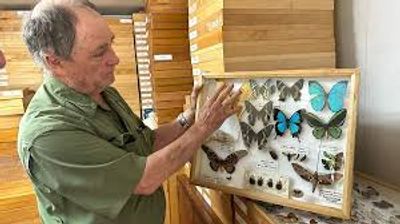
Insect collections are the foundation to understanding the biodiversity of the planet and specific eco- systems – the specimens in collections are essential for describing new species.
Insect collections offer a lens into the past, a snapshot of the present, and a means for predicting the future of how earth’s biodiversity has changed and continues to change in response to climate change and environmental threats.
Insect collections represent a huge database of measurements, chemical compositions, ancient DNA, and other biological information that scientists can use now and in the future.
Insect collections are critical for educating the public about the loss of biodiversity, environmental destruction and the ecological importance of insects.
Insect collections help scientists to rapidly identify invasive insects that affect agriculture, forestry, and human and animal health. Annual U.S. losses due to invasive insects are estimated at $33 billion
API provides 41,000 tons of CO2 reduction annually by substituting fossil diesel with biodiesel. Biodiesel is produced from locally grown agriculture. API creates new, clean, affordable and more environmentally sound, carbon reducing sources of fuel across Uganda, Ethiopia, East Africa. Partnering with landowners to access over 300,000 hectares in Ethiopia through a public-private partnership with the Tigray Regional Government. In Uganda, API has recruited over 10,000 small scale farmers who have planted over 5 million trees. Biodiversity Forever provides field research and environmental biodiversity support to API for reforestation, environment conservation and climate change mitigation. Proper Biodiversity management helps to insure against invasive plant species and insect disease transmission.
Creating a leading Biodiversity Center to serve as model for Africa.
Project includes converting the Kuku Hills Mountain into a Biodiversity Center. The Ku Ku Hills project would also include establishing a Safari-Park for eco-tourism, education and research.
The ultimate goal is to establish an Educational Center and a Natural History Museum with an Insectarium at the University. It would serve as a research and education center and a major local attraction for schools and local population. The project is founded and based on a wide range of cooperation and collaboration including local schools, International Universities, Museums and Scientists.
Project includes:
· Study of the biodiversity of Ku Ku Hills and the surrounding area in order to contribute to its conservation.
· Facilitate the collection of biological material for cooperative research.
· Train local staff and students for the study of Nigerian biodiversity, to generate knowledge on the collected specimens and samples, by means of taxonomical, morphological, ecological, ethological, physiological, phylogeographical and genetic analysis.
Conducting biodiversity surveys with the aim to establish local check lists of species, their regional distribution, and association to ecological zones. Discover, test and document new species and to help conserve their habitats. Biodiversity surveys work as a baseline to identify and protect areas under development from becoming biodiversity hotspots. Work with Museums and University assisting in establishing and building local insect collections to establish local data bases and training young scientists.
Biodiversity and Reforestation Project
In cooperation with Hileni Shivolo, National Museum, Windhoek, Namibia
assisting in establishing and building local insect collections to establish local data bases and training young scientists. Responsible for all aspects of Biodiversity studies including assessments of local species and fauna to ensure effective reforestation that exclude potentially invasive species creating and re-establishing healthy, diverse environments for agriculture, forests and local villages and towns.
Our scientific team has over 2,000 publications. As an example, here are two team members with links to their publications.
President, Founder
Rockville Centre, NY
Contact: 516-946-1936
Epidemiologist, Bamako University
Bamako, Mali
Contact: +49 172 961 4450
Senior Scientist, Chief Curator, THOMAS-WITT-MUSEUM
Munich, Germany
Contact: +49 172 961 4450
AMNH – American Natural History Museum, New York, NY, USA
CMNH – Carnegie Museum of Natural History, Pittsburgh, Pennsylvania, USA
FLMNH – McGuire Center for Lepidoptera and Biodiversity, Gainesville, Florida, USA
FSCA – Florida State Collection of Anthropods, Gainesville, Florida, USA
MPM – Milwaukee Public Museum Milwaukee, USA
SMNH – Smithsonian National Museum of Natural History, Washington, USA
ANHRT – African Natural History Research Trust, Leominster, UK
MFN – Museum für Naturkunde, Berlin, Germany
MHNL – Musée des Confluences, Lyon, France
MNHN – Musée national d’histoire naturelle, Paris, France
MTD – Museum für Tierkunde Senckenberg, Dresden, Germany
NHMUK – Natural History Museum, London, UK
NMW – Naturhistorisches Museum Wien, Austria
SMFL – Senckenberg Museum Frankfurt, Germany
SMNK – Staatliches Museum für Naturkunde, Karlsruhe, Germany
SMNS – Naturkunde Museum, Stuttgart, Germany
ZFMK – Museum Koenig, Bonn, Germany
ZSM – Zoologische Staatssammlung Munich, Germany
ZISP – Collection of the Zoological Institute, St. Petersburg, Russia
TWMF- Thomas Witt Museum and Foundation, Munich, Germany
ASIA
VAST – Vietnam National Museum of Nature, Hanoi, Vietnam
AAM – The Zoological Natural History Museum Addis Ababa, Ethiopia
DNMNH – Ditsong National Museum of Natural History, Pretoria, RSA
MAK – Makarere University of Kampala, Uganda
NHMZ – Natural History Museum, Bulawayo, Zimbabwe
NMK – National Museum of Kenya, Nairobi, Kenya
NMNA – National Museum Namibia, Windhoek, Namibia
ANIC – Australian National Insect Collection, Melbourne, Australia
CSIRO – Natural Research Collections Australia, Acton, Australia
University of Science, Techniques and Technology, Bamako, Mali
Addis Ababa University, Addis Ababa, Ethiopia
Gamal Abdel Nasser University of Conakry, Conakry, Guinea
University of Namibia, Windhoek, Namibia
University of Abuja, Abuja, Nigeria
University of Lagos, Lagos, Nigeria
Busitema University, Soroti, Uganda
Institute of Molecular Biology and Biotechnology, Crete, Greece
Hellas Agricultural University of Athens, Athens, Greece
Ludwig Maximilian University of Munich, Germany
Comenius University Bratislava, Slovakia
Ulyanovsk State Pedagogical University, Ulyanovsk, Russia
University of Florida, Gainesville, Florida
University of South Florida, Tampa, Florida
University of Kentucky, Lexington, Kentucky
Pennsylvania State University., Centre County, Pennsylvania
Yale University, New Haven, Connecticut
Kuvin Center for Tropical and Infectious Diseases, Jerusalem Israel
Technion Israel Institute of Technology, Haifa, Israel
Haifa University, Haifa, Israel
Hadassah Medical School, Hebrew University, Jerusalem, Israel
Lakehead University — Thunder Bay, ON, Canada
McGill University — Montreal, Canada
We use cookies to analyze website traffic and optimize your website experience. By accepting our use of cookies, your data will be aggregated with all other user data.